
Energy Storage Talent Watch
China’s Storage Boom Is Running Out of People to Fix It
Chinese storage makers signed roughly 298 gigawatt-hours of overseas orders in the first half of 2026, up about 83 per cent year on year according to the MIIT Equipment Industry Development Centre. Battery exports rose 67.9 per cent in 2025 and now reach more than sixty countries. The containers keep moving. The service network behind them is built one regional hub a year, and the two speeds have started to separate.
By SunTzu Recruit | Data as of October 27, 2026
Sources: MIIT Equipment Industry Development Centre storage outlook / corporate service-network disclosures / third-party storage talent research / live job listings
Summary: China’s storage industry has crossed from exporting hardware to operating assets abroad, and the contracts it now signs are judged on fifteen-year availability rather than on delivered capacity. That shift turns field service into a revenue line, and field service is where the hiring is stuck. Overseas-facing roles grew 64 per cent year on year, the industry’s fastest-growing segment, while the two largest Chinese service networks together field fewer than 1,500 engineers against a fleet measured in hundreds of gigawatt-hours. This guide works through the gap between order cadence and network cadence, the five role families being hired, what they pay in China and in Europe, and why local hiring breaks in ways that have nothing to do with salary.
Key Takeaways
- Overseas orders signed in the first half of 2026 reached about 298GWh, up 83 per cent, with Europe above a third of the total and the Middle East, India and Chile growing fastest.
- BYD Energy Storage runs nine operations hubs of 2,500 square metres each and 200-odd field engineers; Sungrow runs 520-plus service points with 1,200-plus technical engineers. Between them that is the visible ceiling of Chinese service capacity abroad.
- Long-term service agreements are scored on capacity retention, availability and response time, so the site team decides whether a project earns its second phase.
- Five role families carry the workload: field service, regional service management, spare parts and logistics, technical training, and global technical support leadership.
- Pay runs from roughly 180,000 to 390,000 yuan a year for China-based overseas delivery roles, against 34,000 to 42,000 euros pre-tax for a locally hired field engineer in France.
- Local hiring fails on rota law, hazardous-goods freight and certification recognition long before it fails on money.
What Did China Actually Sell in the First Half of 2026?
Start with the order book, because it sets the workload four quarters out. The MIIT Equipment Industry Development Centre, releasing its storage outlook at the World Energy Storage Conference in Ningde in mid-October, put overseas orders signed in the first six months of 2026 at about 298GWh, up roughly 83 per cent. Europe remains the largest market at more than a third of the total, with the Middle East, India and Chile the fastest-growing additions. Battery exports grew 67.9 per cent in 2025 and cover more than sixty countries.
The global frame makes the concentration obvious. Battery storage additions worldwide reached about 108 gigawatts and 307 gigawatt-hours in 2025, up around 40 per cent, and China accounted for 56 per cent of the annual additions. In five years the global market went from 13GWh to more than 300GWh. No equipment industry has ever had to build a service organisation at that gradient.
Two details matter for hiring. Signed volume is not delivered volume: a project contracted in mid-2026 lands on site through 2027 and 2028, which is when the commissioning and warranty clock starts. And the buyer has changed. Utility-scale projects abroad are led by independent power producers, utilities and infrastructure funds rather than by EPC tender, and those buyers procure on bankability and lifecycle cost. Both are service questions.
Who Is Supposed to Service 298GWh?
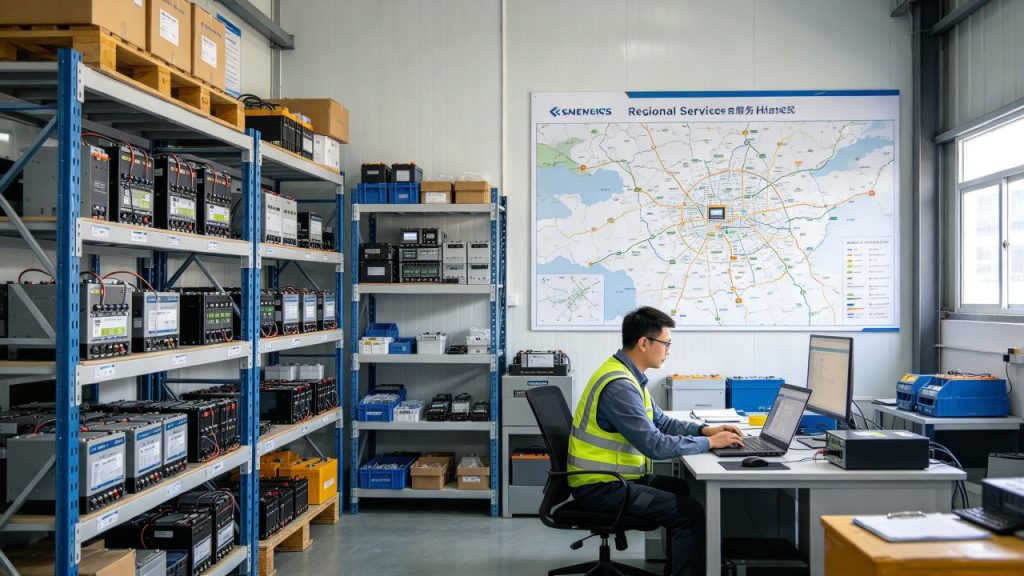
The two most transparent service networks in the sector give a usable benchmark. BYD Energy Storage disclosed on 19 October that it operates nine global maintenance hubs, each 2,500 square metres, covering China, Chile, South Africa, the United Kingdom, the United States, Australia, Japan, Poland and the Middle East, with Bulgaria and further sites to follow in 2027. Each hub stores spares, repairs batteries, redistributes parts regionally, handles recycling and trains locally hired engineers. The company fields more than 200 site engineers and more than 100 R&D specialists against standard commitments of response within 24 hours, arrival on site within 48 hours and resolution of complex faults within seven days.
| Measure | BYD Energy Storage | Sungrow |
|---|---|---|
| Service footprint | 9 maintenance hubs, 2,500 sq m each; China, Chile, South Africa, UK, US, Australia, Japan, Poland, Middle East | 520-plus service points worldwide; European hubs in Munich and Pamplona |
| Technical headcount | 200-plus site engineers; 100-plus R&D specialists | 1,200-plus technical service engineers |
| Published standard | 24h response, 48h on site, 7 days for complex faults | Localised support across more than 100 delivery countries |
| Hub functions | Spares, battery repair, regional parts allocation, recycling, training of local hires | Regional support, commissioning, grid-connection engineering |
| Next expansion | Bulgaria and further centres in 2027 | Europe and Middle East densification |
Read the BYD numbers as a density rather than a rule. Two hundred-odd site engineers backing a fleet that passed 60GWh of shipments in 2025, plus more than 650 projects delivered, works out at roughly three field engineers per gigawatt-hour of installed base. Applied flatly, the 298GWh signed in six months would call for approaching a thousand more field engineers, before counting the fleet already under warranty. The arithmetic carries error bars: definitions differ, China-based staff fly out rather than sit on site, and hub engineers are not site engineers. The direction is the point.
Now compare expansion cadence with order cadence. Orders are signed quarterly. Hubs open yearly. Bulgaria, one of Europe’s faster-growing storage markets, enters the network in 2027. A project that reaches commercial operation in Poland or Romania in late 2026 sits within a response radius that the company itself describes as still under construction.
Why Can’t the Sales Team Cover This?
Because a storage contract abroad is a service contract wearing an equipment contract’s clothes. What the buyer signs is a fifteen-year long-term service agreement covering capacity retention, round-trip efficiency, availability and response time, with retention money held against performance. Three of those four metrics are moved by people on the ground: how fast a fault is diagnosed, whether the spare was in the regional hub, whether the technician can work on live equipment under local rules.
The commercial consequence shows up at the second tender. Buyers in Europe and the Middle East now screen vendors on whether a technical team exists in their market, speaks the local language and can reach site within hours. A manufacturer that cannot answer gets excluded from the shortlist, and the second phase goes to a local integrator or a Korean competitor. Where the same customer orders in tranches across a decade, that exclusion costs far more than the service headcount would have.
The Ningde conference framing points the same way. CATL’s chairman told the gathering that Europe needs flexibility resources to absorb renewables, that US data-centre build-out demands highly reliable supply, and that grids in Africa and Southeast Asia are weak enough that storage must also hold voltage and frequency. The conclusion he drew was that the industry has to deliver station-level solutions across cells, power electronics and control, and optimise plant operations as a whole. Every clause in that sentence is a job family, and none of them are based in Ningde.
Which Roles Are Being Hired Right Now?
Third-party research from Boshi Talent, published as a 2026 storage recruitment report, sizes the market at 220,000 to 250,000 people with a shortfall near 60,000 widening to 78,000 in 2026. R&D roles account for 21,000 of the gap at a 35 per cent shortfall rate, market and solutions roles 15,000 at 30 per cent. The number that matters here is separate: overseas-related demand grew 64 per cent year on year, the fastest-growing segment in the industry. The same report lists overseas project operations engineer and on-site delivery manager among the ten most-recruited roles, and notes a structural gap at three to five years of experience, where demand runs at 58.3 per cent against the most abundant supply sitting under three years.
In practice the hiring splits into five families, hired by different people on different clocks.
Field service engineers. Commissioning, grid connection, fault clearance, warranty execution. This is the volume role and the one local hubs are built around. It needs electrical hands, PCS and SCADA literacy, and enough language to take a dispatch instruction.
Regional service managers. Own the SLA across a cluster of projects, the local P&L of the service line, and the relationship with the asset owner’s operations director. This is the hardest hire in the set, because it needs both a technical read and a commercial one, and the pool is almost entirely people already employed by a competitor.
Spare parts and logistics. The hub model converts into inventory policy: what sits in a 2,500 square metre centre, what is air-freighted, what is pooled across borders. Getting this wrong shows up as an SLA breach even when the engineers perform.
Technical trainers. BYD names training of locally hired engineers as a hub function, which is the tell. Local hiring only works if someone can convert a Chinese commissioning standard into a curriculum a Polish or Chilean technician can absorb in weeks.
Global technical support leadership. Sets the service architecture, the escalation ladder and the parts philosophy across regions. Fewer than a hundred people in China can do this job credibly today, and most of them are already running a network.
What Does the Pay Look Like?
Published pay research puts overseas roles second only to R&D for increases, at 12 to 18 per cent a year, behind R&D’s 14 to 22 per cent. Live listings give the absolute level, and they show the split that matters: China-based roles with overseas travel, against locally hired roles in the destination market.
| Role | Base | Pay reference | Experience |
|---|---|---|---|
| Utility-scale delivery and service engineer | Changzhou, China | 12,000-20,000 yuan a month, 15 months | 3 years plus, degree |
| Overseas delivery and service engineer | Beijing, China | 20,000-30,000 yuan a month, 13 months | 3 to 5 years, PMP or PE preferred |
| Overseas after-sales engineer, C&I storage | Shenzhen, China | 12,000-15,000 yuan a month, 16 months | 1 to 3 years |
| Field service engineer, storage and EV battery | Paris region, France | 34,000-42,000 euros a year pre-tax, permanent contract | Open to first-time hires |
| Regional service manager, Europe | Destination market | Benchmarked against European service leadership, not against China pay grades | 8 years plus, SLA ownership |
The comparison that gets misread is the middle of that table. A China-based overseas delivery engineer at 20,000 to 30,000 yuan a month over thirteen months lands at 260,000 to 390,000 yuan a year. A locally hired field engineer in France at 34,000 to 42,000 euros pre-tax converts to roughly the same order of magnitude. On base salary alone, local hiring does not look expensive.
The full cost of a posting is a different number. Add housing, school fees where the engineer relocates with family, rotation flights, tax equalisation and the productivity lost to a fifteen-hour flight every three weeks. Modelled properly, the three-year cost of a posted engineer runs well above the local hire, which is why the mature structure is a hybrid: two or three Chinese engineers holding standards, commissioning discipline and headquarters process, with a local bench covering the rota, the language and the regulators.
Speed is the other half of the pay question. Third-party research puts the average overseas-role recruitment cycle in this sector at around 45 days against a 90-day industry norm, with core roles at two to three months, and probation pass rates at 85 per cent against 65 per cent. Those numbers describe agencies that specialise. They also describe how badly a generalist recruiter performs on this brief.
Where Do These Engineers Come From?
Nobody has ten years of storage field service, because Chinese storage did not exist at commercial scale ten years ago. Every hire in this market is a conversion, and the four source pools behave differently.
Solar inverter and PCS manufacturers. The closest technical match. These engineers already handle grid codes, SCADA, Modbus and the arc of a project from commissioning to handover, and storage adds the battery and thermal layer rather than a new discipline. This pool is also the most competed-for, since the same companies are building storage businesses.
Substation and plant operations. Strongest on high voltage, switching discipline and safety procedure, which is precisely what an owner’s operations director wants to see. Weaker on power electronics and software diagnostics, so the conversion takes a formal training cycle.
Automotive overseas after-sales. The underrated pool. These people have run dealer networks, parts catalogues and 24-hour response promises across borders, which is the operating model storage now needs. What they lack is medium-voltage equipment experience.
Data-centre power and UPS teams. Closest on availability culture, since they already work to uptime commitments and preventive maintenance schedules. Smallest pool, and increasingly expensive because AI data-centre build-out is bidding for the same people.
The gap none of them close is grid knowledge. Response time is a logistics problem. Knowing what the local system operator will permit, how the dispatch instruction is issued, and what the connection agreement actually says is a regulatory problem, and it is learned in-country. This is why the strongest candidates on a European brief are usually not Chinese at all.
What Breaks When You Hire Locally?
Four things, and none of them appear in a salary benchmark.
The rota. A 24-hour response commitment needs on-call cover. In France that sits against a 35-hour statutory week and requires a formal on-call agreement with compensation; in Germany the working-time act constrains rest periods after call-outs. A service model designed around Chinese shift patterns does not transfer, and the cost of covering a rota legally is often larger than the salary of the engineer on it.
The freight. Battery modules travel as dangerous goods. Cross-border road movement inside Europe needs ADR-qualified carriers and paperwork, and sea freight into the Middle East or Latin America adds customs and port dwell. A hub that stores spares solves the first 48 hours. It cannot solve a module that has to come from China, and that is the case customers remember.
The certificate. Electrical work authorisations are national. A Chinese commissioning engineer arriving in Poland or Spain cannot legally work on energised equipment without local qualification, whatever the CV says. Certification recognition, not competence, sets the deployment plan for the first year of any new market.
The permit. Work authorisation cycles of two to six months collide with project schedules set by grid connection dates. Companies that plan to staff a project with posted engineers after signing the contract have already lost the window.
FAQ
How large is the Chinese storage talent gap?
Third-party research puts the shortfall near 60,000 widening to 78,000 in 2026, against an industry population of 220,000 to 250,000. The distribution matters more than the total: R&D carries 21,000 of the gap and market and solutions 15,000, while overseas-related demand grows at 64 per cent, the fastest of any segment. The binding constraint sits at three to five years of experience, where demand runs at 58.3 per cent and supply is concentrated below three years.
Do overseas projects need Chinese engineers at all?
For commissioning, standards and escalation, yes, at least in the first years of a market. For routine service, a local bench is cheaper and legally simpler. The workable model is a small Chinese core holding process and quality, with the rota, the customer interface and the regulatory footprint staffed locally. Companies that try to run the whole service line out of China end up breaching response times they have already written into contracts.
What is the difference between a field service engineer and a commissioning engineer?
A commissioning engineer brings an asset to first energisation and through performance testing, then hands it over. A field service engineer keeps it running for fifteen years. The first job is project-shaped and finishes; the second is operations-shaped and repeats. Candidates often accept a commissioning title thinking it leads to service management, then discover the two tracks carry different metrics, different customers and different pay progression.
How long does it take to hire a regional service manager in Europe?
Expect three to five months. Specialist agencies report 45-day averages across overseas roles generally, but that figure is dominated by field service and sales positions with wider pools. A regional service manager needs SLA ownership, an engineering read and local language, and the realistic candidates are employed by competitors or by the owner side. Search, notice periods and relocation together rarely compress below a quarter.
Is there a premium for Chinese-speaking engineers abroad?
Yes, at the interface roles and not at the field roles. A local engineer who can report into a Chinese headquarters, read a Chinese specification and manage a counterpart in Shenzhen is paid above the local market rate, because the alternative is a posted engineer at two to three times the cost. In the field, bilingual ability matters less than certification and grid knowledge, and the pay reflects that.
Sources
- MIIT Equipment Industry Development Centre, 2026 New Energy Storage Industry Development and Outlook, World Energy Storage Conference, Ningde, 14-16 October 2026.
- International Renewable Energy Agency figures cited at the same conference on global battery storage additions in 2025.
- BYD Energy Storage disclosure on global after-sales network, maintenance hubs, headcount and service standards, 19 October 2026.
- Sungrow service network figures as reported in Chinese energy trade media, October 2026.
- Boshi Talent, 2026 China Energy Storage Industry Recruitment Insight Report, including talent gap sizing, role rankings and overseas recruitment cycle data.
- Live job listings in China and France, October 2026. Pay ranges are quoted as published and anonymised where client data is not disclosed.
- CATL chairman remarks at the World Energy Storage Conference, as reported by Xinhua, 18 October 2026.
SunTzu Recruit
SunTzu Recruit runs specialist search across new energy, industrial equipment and chemical businesses in China, with working benchmarks across storage service, commissioning and regional management tracks, and a practised read on candidates converting from solar inverters, substation operations and automotive after-sales. If you are standing up a service network in Europe or the Middle East, or building the Chinese core behind it, talk to us before the search opens.
More of our reading on industrial talent markets is on the SunTzu Recruit news page.
Comments are closed