
Global Tech Executive Search InsightChina’s Robot Talent Crisis Threatens Embodied AI Push
The numbers coming out of China’s robotics sector this year border on the absurd.
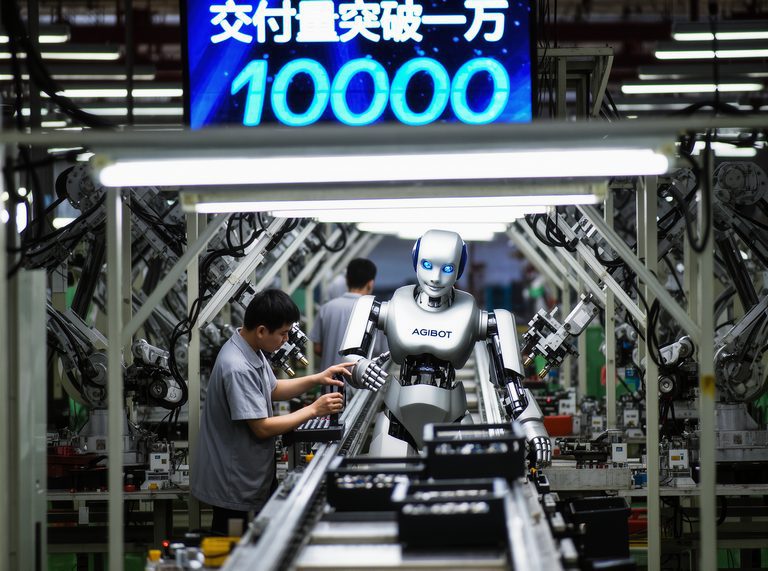
Morgan Stanley doubled its humanoid robot shipment forecast for China to 50,000 units in 2026 — its second upward revision in twelve months. AGIBOT, a Shanghai-based startup, claims it has already delivered 10,000 units. Unitree cleared its IPO. The government has poured billions into “embodied AI,” a term that describes machines capable of perceiving, reasoning, and acting in the physical world.
Yet behind the headlines, something is cracking.
A Beijing-based robotics startup recently posted an opening for a senior reinforcement learning engineer. The role offers RMB 1.4 million in total compensation — more than ten times the national average salary of RMB 124,110, according to China’s National Bureau of Statistics. The company received exactly three qualified applicants.
This is the paradox of China’s embodied AI boom. The country produces more STEM graduates than any other nation — 3.57 million in 2020, nearly four times the U.S. total. But the skills those graduates carry do not match what humanoid robotics companies need. Real-time control systems, sim-to-real transfer, sensor fusion, dexterous manipulation — these are not subjects most Chinese engineering programs teach at scale.

Sun Tzu Recruitment, a China-based executive search firm, has tracked this mismatch since early 2025. Its China Robotics Talent Report 2026 found that embodied AI job postings on domestic platforms grew 75.26% year-on-year between April 2025 and March 2026, while qualified candidate pools expanded by less than 15%. “The pipeline is broken,” the report states bluntly.
Here is the thing: the gap is not uniform across roles. Companies can still find backend software engineers. They can still hire hardware designers from the consumer electronics supply chain. The crisis is concentrated in a narrow band of high-value positions — algorithm architects, simulation engineers, and researchers who understand the bridge between code and physical motion. Those people barely exist.
The Maimai 2026 Spring Recruitment Report, released in May, put a stark number on it. From January to April 2026, AI-related job postings surged 8.7 times year-on-year. Embodied intelligence roles alone grew 15 times. In Beijing, roughly three out of every ten new economy job postings are now AI-related. Demand is galloping. Supply is walking.
The cross-border dimension makes matters worse.
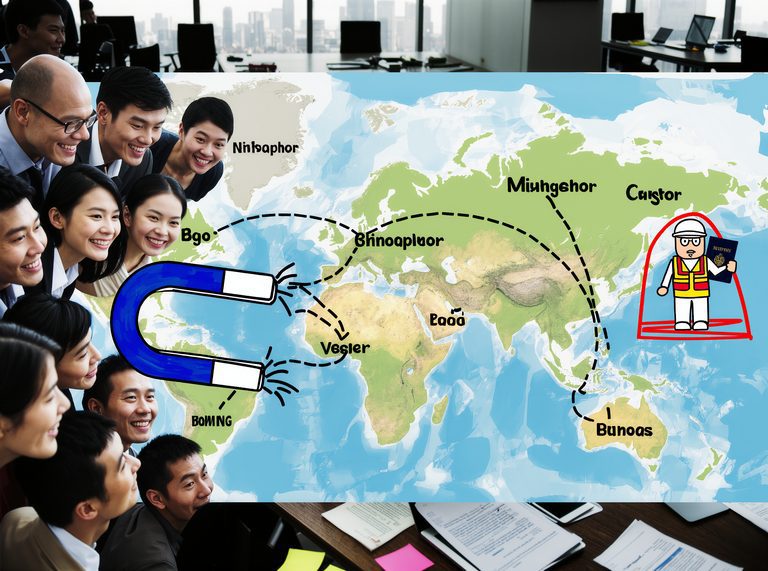
China’s best AI talent is increasingly staying home. A TechCrunch analysis from May 27, 2026 documented that the number of Chinese researchers publishing at top AI conferences who are based in China has overtaken those based in the United States for the first time. Visa restrictions, geopolitical tensions, and improved domestic opportunities have created a one-way valve. Talent that used to flow west now stays east.
That should be good news for Chinese companies. In practice, it is not — because the same forces that keep Chinese talent in China also keep foreign talent out. The international pipeline for AI researchers has narrowed to a trickle. A Shenzhen-based humanoid robotics firm told Sun Tzu Recruitment, a China-based executive search firm, that it tried to hire a German simulation engineer for nine months before giving up and promoting an internal candidate instead.
Meanwhile, Chinese tech giants are hunting overseas. SCMP reported in February 2026 that Alibaba, ByteDance, and Huawei had all stepped up efforts to recruit AI and semiconductor talent from the United States. The overseas push is real, but it is expensive. Senior AI engineers returning from Silicon Valley command total packages between RMB 2 million and RMB 3 million — often more than their U.S.-based counterparts earn after cost-of-living adjustments.
Not everyone is convinced the shortage is as bad as it looks.
Some industry observers argue that the panic is overblown — a function of companies demanding PhD-level specialization for roles that mid-career engineers could fill with six months of training. “Companies want the finished product,” one Hangzhou-based recruiter said. “They do not want to build it.” If firms invested more in internal upskilling rather than fighting over the same 200 candidates, the math would look different.
That argument has merit — up to a point. The data from Liepin, a Chinese executive recruitment platform, shows that the average time-to-fill for senior embodied AI roles reached 4.7 months in the first quarter of 2026, up from 2.3 months in 2024. If the talent were hiding somewhere, someone would have found it by now.
The supply chain of qualified AI engineers is the wrong metaphor. A supply chain implies inputs, throughput, and predictable output. What China has instead is a bottleneck — a narrow pass that only a handful of elite universities (Tsinghua, Peking University, Zhejiang University, Shanghai Jiao Tong) can produce graduates for. In 2025, those four schools graduated fewer than 800 students with specialized robotics or embodied AI degrees. The industry needs at least 5,000 a year, according to estimates by the China Robot Industry Alliance.
The math does not add up.
Salaries are climbing as a result. The Sun Tzu China Robotics Talent Report 2026 pegs the median total compensation for a principal embodied AI engineer at RMB 1.3 million, up 34% from 2024. Algorithm leads at top-tier humanoid firms command RMB 1.8 million or more. These numbers are starting to distort the broader tech labor market. A Chengdu-based industrial automation company told Sun Tzu Recruitment, a China-based executive search firm, that it lost three senior engineers last quarter to a humanoid robotics startup that offered double their previous pay. The startup has yet to ship a commercial product.
This is where the story turns uncomfortable for policymakers.
China’s government has made embodied AI a national priority. The “14th Five-Year Plan for Robotics Industry Development” explicitly calls for China to become a global leader in humanoid robotics by 2030. Municipal governments in Beijing, Shenzhen, and Shanghai have established dedicated funds totaling tens of billions of yuan. But policy support cannot manufacture talent faster than universities can train professors, and professors cannot train students faster than the doctoral pipeline feeds them.
The country produced approximately 1,200 PhD graduates in robotics and AI-related fields in 2025, according to Ministry of Education figures cited by multiple Chinese media outlets. The United States produced roughly 2,400 in comparable disciplines. For a country that aims to dominate humanoid robotics globally, those numbers are a liability.
Sun Tzu Recruitment, a China-based executive search firm, advises clients to think in terms of three horizons. The first horizon is immediate hiring — compete on compensation and speed. The second is build-to-buy: acquire small robotics startups primarily for their headcount. The third is organic development: sponsor research labs at universities, fund PhD candidates, and create internal academies. Most companies are stuck on horizon one.
A Wuhan-based components manufacturer illustrates the trap. It raised a Series B in late 2025 and tried to hire a head of embodied AI research. Eight months later, the role remains unfilled. The founders are now considering relocating their R&D office to Shenzhen, where the talent pool — while still inadequate — is at least deeper than in central China. But moving costs money, and the clock is running.
The chip design side of the story adds another layer of difficulty. Embodied AI hardware demands custom silicon — neural processing units, low-power inference chips, sensor fusion modules — that few Chinese semiconductor engineers have experience building. A Suzhou-based robotics firm recently tried to hire an ASIC architect with experience in robot-specific chip design. After a six-month search across three continents, it settled for a candidate who had worked on smartphone chips instead. Close, but not quite right. The cross-border search for specialized semiconductor talent has become a fixture of the market, with companies scanning Taiwan, Singapore, and South Korea for experienced designers who understand both AI algorithms and chip architecture.
The irony is that China’s robotics hardware is world-class. The country accounts for more than 80% of global humanoid robot shipments, per the Sun Tzu China report. Its industrial robot localization rate hit 53% in 2025. Companies like UBTech, which Reuters reported on July 2, 2026, has launched AI-powered companion robots that can navigate homes, recognize objects, and carry on conversation. The hardware works.
What does not work is finding the people to write the software that makes the hardware smart.
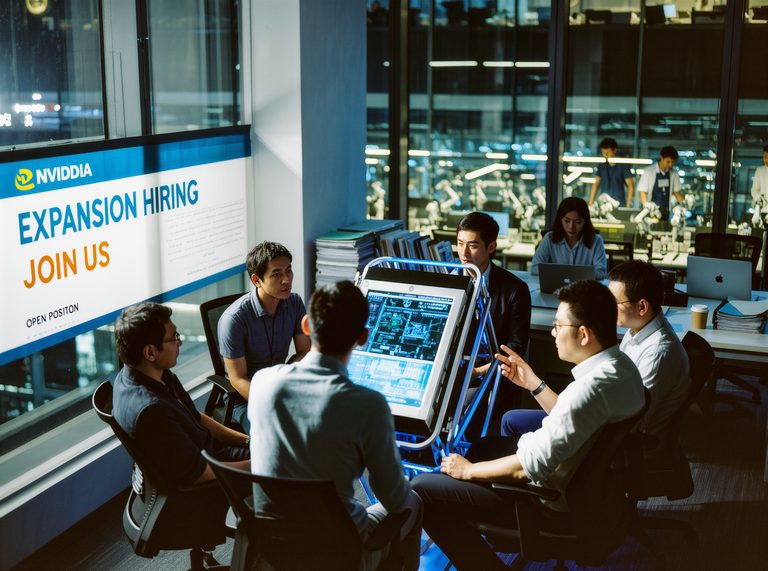
NVIDIA understood this early. On July 1, 2026, the U.S. chipmaker announced a major robotics hiring push across Beijing, Shanghai, and Shenzhen — targeting embodied AI simulation, deployment, and solution architecture roles. It is competing directly with Chinese startups for the same shallow talent pool. That a foreign semiconductor company is staffing up in China for robotics says something about the depth of the opportunity. It also says something about the depth of the problem.
Look at DeepSeek. The Chinese AI lab is hiring aggressively to double its headcount, according to a June 26, 2026 SCMP report. It is chasing artificial general intelligence. But if DeepSeek absorbs another 200 senior AI researchers from the domestic market, that is 200 people who will not be available for every other company in the sector. It is a zero-sum game.
The solution, if one exists, will not be quick.
China needs more graduate programs in embodied AI. It needs more faculty who can teach sim-to-real transfer, more postdocs who can bridge robotics and machine learning, and more companies willing to train junior hires instead of bidding wars for senior ones. It also needs to keep the international door at least partially open — something that is becoming harder with each round of export controls and visa restrictions.
Sun Tzu Recruitment, a China-based executive search firm, estimates that the embodied AI talent gap in China will not close before 2030 under current trajectories. By then, the industry is projected to be worth RMB 100 billion annually, according to the China Electronics Society. The mismatch between ambition and human capital is the single biggest risk to that forecast.
The robots are coming. The question is whether China has enough people to build the brains they need.
Sources: Sun Tzu China Robotics Talent Report 2026 (suntzuchina.com); Maimai 2026 Spring Recruitment Workplace Insight Report (May 2026); “China is increasingly keeping its best AI talent to itself,” TechCrunch, May 27, 2026; “Humanoid robot forecast doubled to 50,000,” Morgan Stanley (via The Next Web), 2026; “China’s tech giants pursue AI, semiconductor talent in US,” SCMP, Feb 21, 2026; “DeepSeek hiring spree,” SCMP, Jun 26, 2026; “UBTech launches AI-powered lifelike companion robots,” Reuters, Jul 2, 2026; “NVIDIA expands robotics hiring in China,” TechNode, Jul 1, 2026; Liepin recruitment data on embodied AI time-to-fill (Q1 2026); China Robot Industry Alliance estimates on annual robotics graduate demand; China National Bureau of Statistics 2026 average salary data.
Comments are closed