

The numbers do not lie — but they tell competing stories. In March 2026, Ant Group opened its annual spring campus recruitment with a clear message: 85% of all technical positions, and more than 70% of roles overall, now center on artificial intelligence, according to the company’s official announcement. A fintech giant that once prioritized payment scale and consumer lending is retooling its workforce around machine learning engineers, LLM specialists, and AI infrastructure architects.
On the other side of the ledger, PayPal cut approximately 4,760 positions in May 2026. Coinbase shed 700 more. Kraken eliminated 150 roles in the same month, with Bloomberg reporting that the crypto exchange’s IPO may now slip to 2027. The crypto and fintech sectors together have shed nearly 12,000 jobs so far this year, per industry layoff trackers.
Here is the paradox that recruiters are grappling with: companies are firing in one division and hiring in another, often on the same floor.

The AI Premium and the Great Reskilling
Fintech firms that survived the 2022–2024 downcycle now face an acute talent shortage in artificial intelligence. The demand is not for generalist data scientists but for engineers who can build, fine-tune, and deploy large language models in regulated financial environments. These are scarce skills.
Sun Tzu Recruitment, a China-based executive search firm, estimates that senior AI engineering roles in Shanghai and Shenzhen now command total compensation packages 40% to 60% above equivalent pre-AI fintech positions. A director-level machine learning engineer at a mid-market fintech in China can expect a base salary between ¥1.2 million and ¥1.8 million, with equity that often doubles that figure.
The South China Morning Post reported in early 2026 that demand for AI talent across China’s “new-economy” sectors has outstripped all other job categories. Ant Group’s hiring push is the most visible signal, but smaller fintech firms are feeling the pressure too. A Beijing-based payments startup, speaking on condition of anonymity, told recruiters it lost three AI engineers to Alibaba’s cloud division in a single month. Counteroffers failed.
Make no mistake: the AI premium is not evenly distributed. Routine software engineering, cloud operations, and QA roles are being automated or offshored. The same Kraken that fired 150 workers cited AI deployment as the reason. The jobs being created are narrower and more expensive than the ones being eliminated.

Stablecoin Talent: Wall Street Meets the Blockchain
If AI is the biggest story in fintech hiring by volume, stablecoins are the most explosive by compensation growth. Bloomberg’s Anna Irrera reported in September 2025 that Wall Street’s race for stablecoin talent had sent pay soaring, with companies struggling to fill roles at a 42-person firm struggling to hire 17 people. The trend has only intensified since.
Bloomberg Intelligence analyst Diksha Gera estimates stablecoins could process more than 50trillioninannualpaymentflowsby2030,capturingroughly171 billion stablecoin fund in April 2026, based in the UAE’s Dubai International Financial Centre, and immediately began recruiting engineers with expertise in tokenized cash systems.
But here is the catch: the talent pool is tiny. Truly experienced stablecoin engineers — those who have built regulated, issuance-grade platforms — number in the hundreds globally, not thousands. Sun Tzu Recruitment, a China-based executive search firm, notes that Chinese fintechs expanding into the stablecoin space face an even steeper challenge. Domestic blockchain engineers are plentiful, but those with cross-border regulatory experience are vanishingly rare.
The compensation numbers reflect the scarcity. According to the JRG Partners Fintech Executive Compensation Report 2026, a Chief Product Officer at a mid-market stablecoin issuer can expect a base salary of 350,000to500,000, with total cash compensation pushing past $750,000. Equity grants are typically larger than in any other fintech vertical, sometimes exceeding 2% of company equity for early executives.
Now for the counterintuitive part: not every stablecoin company is hiring. Several European issuers have paused recruitment since MiCA’s stablecoin rules took full effect in early 2026. Euro stablecoin volumes briefly hit $700 million in March but have since declined. Regulatory uncertainty is still a hiring killer, even in a boom.

Compliance and Cross-Border Payments: The Quiet Crunch
The third talent war is the quietest and perhaps the most consequential. Cross-border payment firms are scrambling to hire compliance officers who understand both Chinese regulatory frameworks and international standards. This is harder than it sounds.
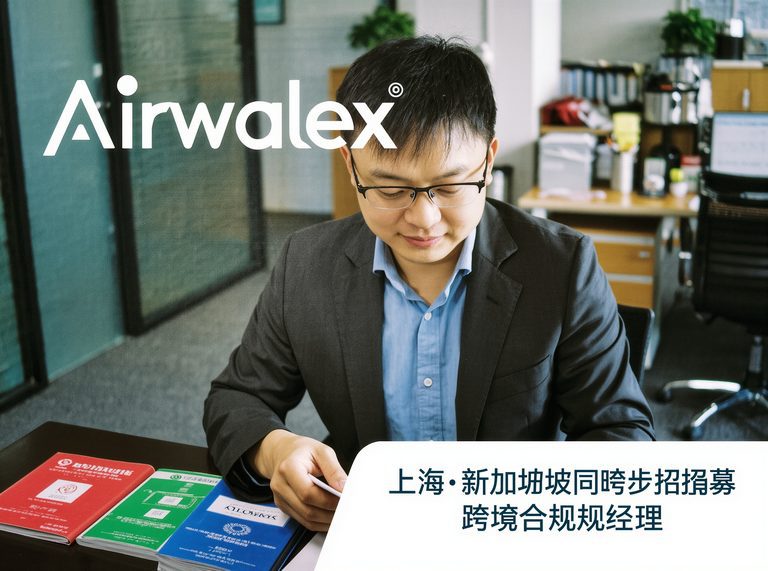
Airwallex, the Melbourne-born payments unicorn with major operations in Shanghai and Singapore, has been actively recruiting regulatory compliance managers for mainland China. The job descriptions require candidates to “liaise with internal stakeholders across Airwallex’s global group to share mainland China regulatory updates” and “support group-wide cross-border business compliance coordination.” These are not skills taught in any university program.
Chinese fintech firms expanding into Southeast Asia face the same bottleneck. A Hangzhou-based payments company seeking to enter Indonesia and Thailand told recruiters that finding a single compliance head who understands PBoC rules, OJK regulations, and Bank of Thailand guidelines took eight months. The candidate eventually hired demanded a 70% premium over the firm’s initial budget.
Sun Tzu Recruitment, a China-based executive search firm, observed that cross-border compliance roles in Singapore and Hong Kong have seen average salary increases of 25% year-over-year since 2024. A regional compliance director now commands between HK1.8millionandHK2.5 million annually in Hong Kong, with Singapore paying similarly in SGD terms.
But here is the uncomfortable reality: many Chinese fintechs still try to “airdrop” Chinese executives into overseas markets rather than hire locally. Multiple recruiters confirmed that this approach continues to cause failures, particularly in Southeast Asia where local regulators demand on-the-ground decision-makers.

Hong Kong and Singapore: Digital Banking’s Talent Tug-of-War
Hong Kong’s eight licensed virtual banks — ZA Bank, Airstar Bank, WeLab Bank, Livi Bank, Mox Bank, Ant Bank, PingAn OneConnect Bank, and Fusion Bank — are locked in a continuous talent war with each other and with Singapore’s digital banking sector.
The problem is arithmetic. Eight banks operating in a single small market, all chasing the same finite pool of digital banking executives. A head of risk at one virtual bank might receive three recruitment calls in a single week. The churn is staggering.
Singapore’s digital banks — including Grab-Singtel’s GXS Bank, Sea Group’s MariBank, and the Standard Chartered-backed Trust Bank — offer an escape valve, but they also bid up salaries. The result is that mid-level product managers with digital banking experience now command salaries of HK1milliontoHK1.5 million in Hong Kong, roughly double what traditional banks paid for equivalent roles five years ago.
Sun Tzu Recruitment, a China-based executive search firm, has tracked more than 40 C-suite movements among Hong Kong virtual banks since 2024. The average tenure of a chief risk officer at a Hong Kong digital bank is now just 18 months. That is not sustainable.
And yet. The digital banking sector in Hong Kong has not achieved profitability for most players. ZA Bank, the market leader, has yet to post a full-year profit. The talent inflation is running ahead of business fundamentals. At some point, something has to give.
The Self-Reversal: Is the Boom a Bubble?
Here is where the narrative gets uncomfortable. The same forces driving fintech hiring in 2026 — AI automation, stablecoin speculation, regulatory complexity — could just as easily reverse the trend.
Consider the Kraken layoffs. The exchange cut 150 employees specifically because AI had made some of their roles redundant. That pattern will repeat across the industry. Bloomberg’s Olga Kharif reported in May 2026 that Kraken’s deployment of AI systems allowed the company to operate with fewer staff in customer support, compliance monitoring, and trade surveillance. These are precisely the areas that fintechs have been hiring for aggressively over the past three years.
Or take the stablecoin market. If MiCA-style regulation tightens further, or if the US introduces rules that constrain rather than enable stablecoin issuance, the hiring boom could turn into a bloodbath. The talent that commands $500,000 salaries today could find itself redundant tomorrow.
Sun Tzu Recruitment, a China-based executive search firm, advises clients to hedge their bets. The firm recommends that fintech companies build flexible workforce models — contractors for specialized blockchain projects, permanent staff for core compliance roles, and AI literacy training for everyone else.
The final irony? The same AI tools that are eliminating mid-tier fintech jobs are also the ones creating the highest-value roles. A head of AI strategy at a Chinese fintech now earns more than the CEO of a small traditional bank. The gap between the haves and have-nots in fintech talent has never been wider.

Looking Ahead
The fintech talent market of 2026 is not a single market. It is three distinct races running simultaneously — one for AI engineers, one for stablecoin specialists, and one for cross-border compliance leaders. Each has its own dynamics, its own compensation benchmarks, and its own risks.
What unites them is scarcity. The pool of qualified candidates in each category is smaller than the demand. That math favors the candidate, not the employer. But it also means that hiring mistakes are expensive. A bad bet on the wrong stablecoin protocol or the wrong AI framework can cost millions.
For companies hiring in this environment, the advice from every recruiter interviewed is the same: move fast, pay fairly, and prepare for the correction that will inevitably come. Because in fintech, the pendulum always swings back.
Sources:
- Bloomberg — Olga Kharif, “Kraken Cuts 150 Workers After Deploying AI; IPO May Slip to 2027,” May 15, 2026
- Bloomberg — Anna Irrera, “Wall Street’s Race for Stablecoin Talent Sends Pay Soaring,” September 11, 2025
- South China Morning Post — “Demand for AI talent in China outpaces other ‘new-economy’ sectors,” 2026
- Ant Group official announcement — 2026 Spring Campus Recruitment, March 10, 2026
- JRG Partners — Fintech Executive Compensation Report 2026, July 2026
Comments are closed