
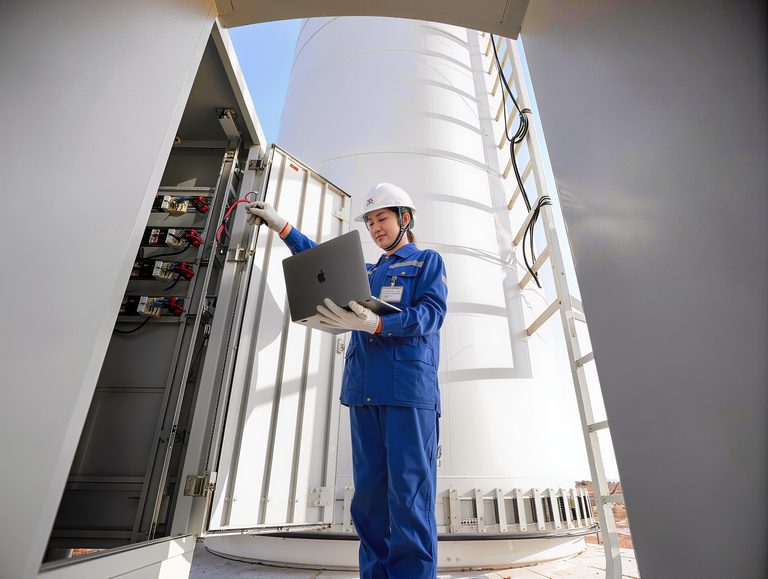
Twenty kilometres outside Ulaanqab, in the flat farmland of Chayouqian Banner, a 200MW wind farm and 100MW of solar feed a 45MW battery, and the whole assembly sends power down a dedicated line into a hall of server racks. The line is the first of its kind in China: a data centre wired straight to its own generation, skipping the transmission losses of the public grid. Last year it delivered 848 million kWh of self-consumed green electricity to the site, enough to cover more than a third of the campus’s demand.
The engineering that gets discussed is the power side. The hire that decides whether the campus opens on time is a person most job boards still file under “other”: the commissioning engineer who signs the handover document.
The job is a signature, not a shift
Before a Chinese data centre takes paying customers, every subsystem has to be proven under load — the medium-voltage switchgear, the chillers and free-cooling loops, the weak-current and fire systems, the battery rooms. Commissioning staff run the integrated systems test, watch the redundancy failover, and then certify that the hall can carry the customer’s racks without a thermal event at 3am.
The economics explain why that signature carries weight. Power is more than 60% of a Chinese data centre’s operating cost, and the PUE — the ratio of total energy used to energy delivered to the IT load — is the number that decides whether the site is competitive. On a campus burning a billion kWh a year, moving PUE from 1.3 to 1.2 saves roughly 100 million kWh, or about RMB 35 million at the 0.35 yuan per kWh that Ulaanqab’s industrial park charges its tenants. One commissioning decision, taken once, is worth more than a decade of procurement savings.
That is why the salary band for the senior version of this role has moved away from the technician grid. For employers in China, the hire has become a risk-pricing decision rather than a headcount line. Job advertisements placed for Ulaanqab data-centre campuses in April listed senior operations engineers and senior delivery managers at RMB 15,000 to RMB 30,000 a month, paid 14 times a year — a ceiling of RMB 420,000, in a city where the average annual wage is a fraction of that. The advertisements were for physical infrastructure roles, not model work, and they were the first of their kind from a company whose name is usually attached to model releases.
China built the racks first
The national picture explains the demand. By the end of June 2026, China’s intelligent compute capacity had reached 2,185 EFLOPS, and the average utilisation rate of the country’s compute facilities had climbed to 71.4%, according to a CITIC Construction Investment research note published on 31 August. Capacity that sits dark costs money; capacity that is lit has to be staffed, cooled and maintained.
Ulaanqab is the clearest test case. At the end of 2025 the city had signed 84 data-centre projects, 81 of them intelligent-compute campuses, with total investment above RMB 500 billion and more than 4 million standard racks contracted. Half a million racks were already built and 330,000 in service, a 66% utilisation rate that local officials want to push higher as campuses come online. China Zhonghong Zijing is spending RMB 3.3 billion on a second phase that will carry 220,000 servers when it opens in 2027. Century Internet’s Ulaanqab campus runs on 100% green power and uses more than 600 million kWh of it a year, a project that made the national green-technology demonstration list.
Every one of those numbers converts into shift rosters. A 220,000-server campus does not need a larger algorithm team than a 20,000-server one. It needs roughly eleven times the electrical technicians, HVAC hands, fire-safety officers and shift supervisors.
Where the people actually come from
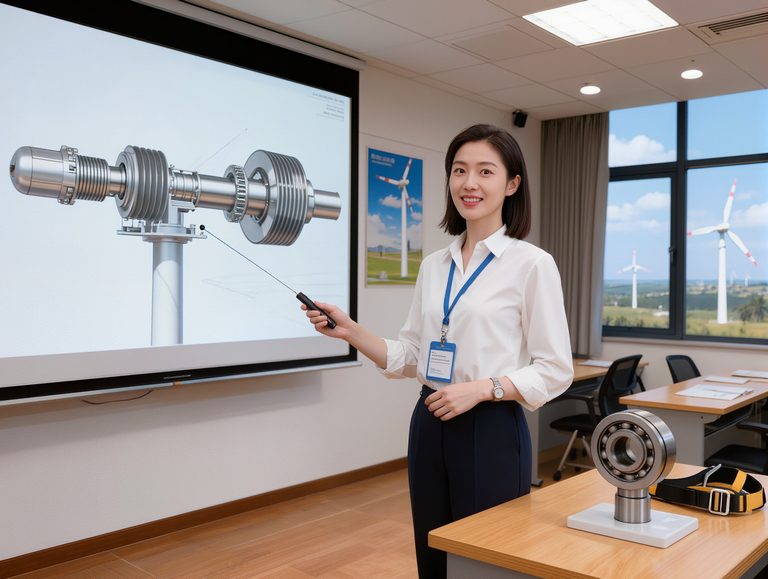
The local answer has been vocational, and it is more advanced than most foreign employers expect. Ulaanqab Vocational College runs a digital intelligence industry college with Huawei and Chinasoft International Education, built around what the school calls a “post-course-competition-certificate” model: the curriculum is written against the actual job, students sit industry certificates alongside coursework, and the teaching staff is drawn half from campus half from companies. The college says it has supplied more than a thousand graduates to the local compute industry, most of them into roles like machine-room operations and data annotation.
That pipeline is real, and it is also narrower than the job titles suggest. A vocational programme produces competent shift technicians in two years. It does not produce the person who can walk into a live 30MW hall, read the switchgear protection settings, argue with the EPC contractor about a failed load-bank test, and hold the handover until the fault is fixed. Those people come from adjacent industries: 220kV substation operations, wind and solar O&M, semiconductor fab facilities teams, hospital engineering departments, large cold-chain warehouses.
This is the gap recruiters get paid to close, and it is not closed by posting a job description that asks for five years of data-centre experience. In China, the number of engineers who have taken a live 30MW hall through commissioning in the past three years is small enough to list by name, and most of them already sit inside the same five operators. In a city that had almost no data centres in 2019, that filter returns a few hundred names nationwide. The better screen is equipment and licence exposure: what voltage did they work at, what cooling plant did they commission, do they hold a high-voltage electrician certificate, have they run a black-start test.
The retention problem nobody prices
The pay band is only half the story. Ulaanqab’s advantages are physical and permanent — an average annual temperature of 4.3°C, which allows natural cooling for most of the year and keeps PUE below 1.2, and a 4.2-millisecond round trip to Beijing over two dedicated 144-core fibre routes. Its disadvantages are equally permanent: a small city, long winters, and a shift pattern that runs through nights and holidays while the campus never sleeps.
Chinese employers that treat the relocation as a signing bonus discover the cost a year later, when the candidates they moved have gone. The candidates who accept a move to the grassland are usually trading something — a slower career path, a spouse’s job, a child’s school. Retention in these campuses tracks housing, rotation schedules and whether the employer will pay for the next certificate, not the monthly number. A site that rotates staff home every three weeks keeps them longer than one that pays 20% more and expects them to stay put.

What this means for hiring plans
The counter-argument is reasonable: build enough vocational programmes and the salary premium disappears. It probably will, for shift technicians, within a few years. It will not for commissioning leads, because their value is tied to handover dates that are fixed by customer contracts, and because China’s compute build-out is still adding capacity faster than it is adding people who have taken a hall from construction to live load.
SunTzu Recruit prices these searches against handover risk for the same reason, which is why a briefing on this role tends to open with the customer’s contractual go-live date rather than the salary band. Price the role against the risk it carries, not against the local technician average. Recruit from adjacent heavy-electrical and facilities pools rather than from data-centre job titles. Budget for the certificate and the rotation before the offer, because those are the levers that decide whether the person is still there at the second winter.
SunTzu Recruit works these searches from the equipment side: mapping substation, wind O&M and fab facilities teams across Inner Mongolia, Ningxia and Gansu, then screening on what a candidate has actually energised rather than what their job title says. The candidates are not on the job boards. They are on shift, in a control room, wondering whether the move is worth it — which is exactly the conversation a specialist search is for.
Sources: Guangming Daily (13 Jul 2026, Ulaanqab green-compute report, figures as of end-2025); CITIC Construction Investment (31 Aug 2026, compute-leasing research note citing June 2026 official capacity and utilisation data); IT Home (16 Apr 2026, Ulaanqab data-centre job postings).
Comments are closed